support@jewelsamrat.com


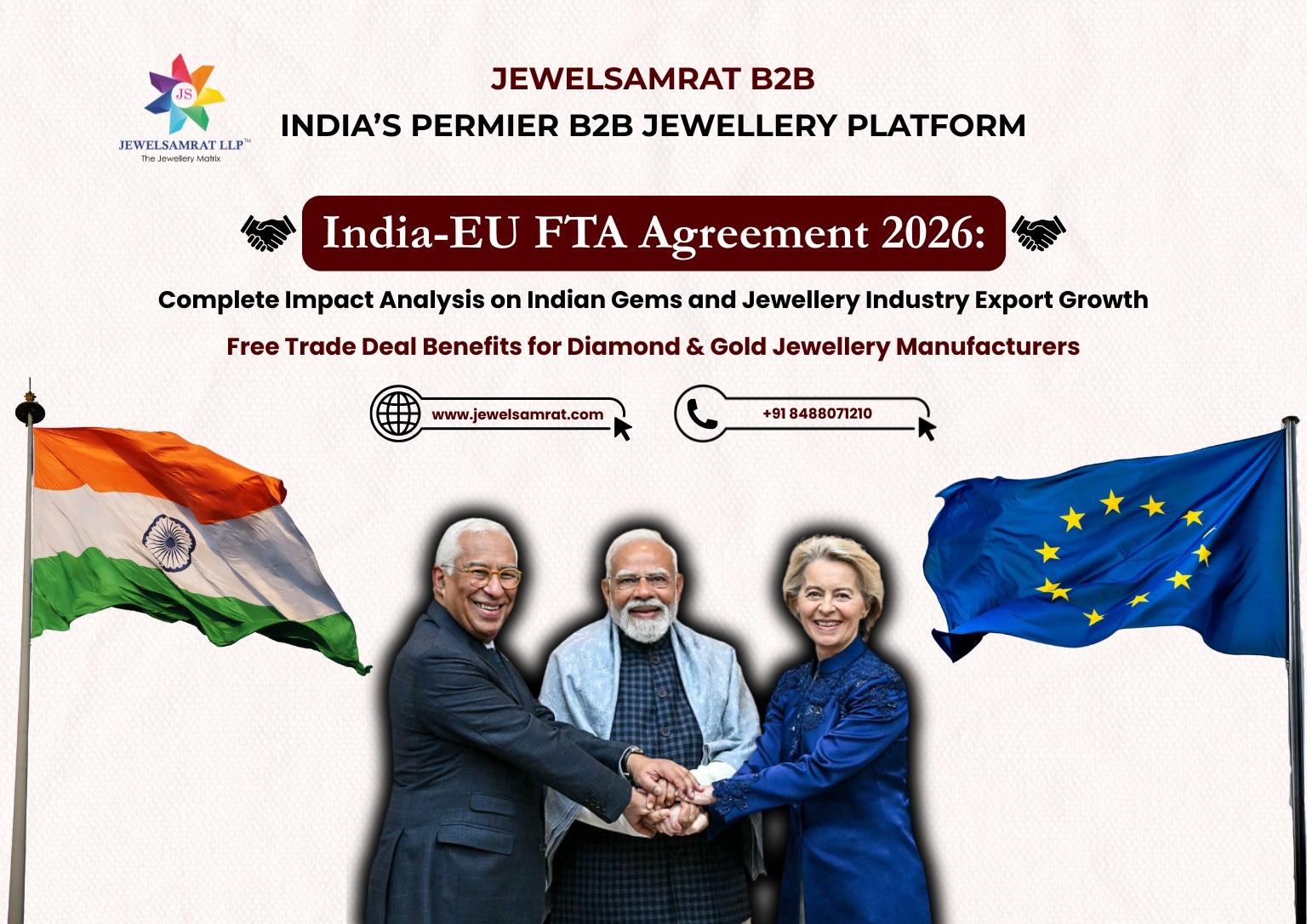
India-EU FTA Agreement 2026:
Complete Impact Analysis on Indian Gems and Jewellery Industry Export Growth|
Free Trade Deal Benefits for Diamond & Gold Jewellery Manufacturers
How India-EU Free Trade Agreement 2026 transforms jewellery exports | Tariff elimination benefits for diamond manufacturing, gold jewellery, gems and jewellery sector growth strategies
Published: January 27, 2026 | Updated for India-EU Trade Deal 2026
The India-European Union Free Trade Agreement 2026 (India-EU FTA), concluded on January 27, 2026, marks a transformative milestone for India's gems and jewellery industry. This landmark free trade deal between India and EU, described by Prime Minister Narendra Modi as the 'mother of all deals,' creates unprecedented export opportunities for Indian jewellery manufacturers, diamond exporters, and gold jewellery businesses targeting European markets. The bilateral trade agreement eliminates tariff barriers, opening a market of 450 million affluent European consumers to Indian gems and jewellery products.
This comprehensive India-EU trade partnership agreement encompasses 25% of global GDP and one-third of world trade, creating a free trade zone for jewellery exports that positions India's US$ 28.5 billion gems and jewellery sector for exponential growth. For jewellery industry stakeholders—from Surat diamond manufacturers to Mumbai gold jewellery exporters and traditional Kundan-Meenakari artisans—the EU FTA 2026 represents nothing short of a renaissance in international jewellery trade.
India's gems and jewellery manufacturing industry, with its rich 5,000-year heritage, has evolved into a dominant force in global jewellery exports. The Indian jewellery sector contributes 7% to India's GDP and employs over five million skilled artisans in jewellery manufacturing, diamond cutting, gold ornament production, and precious gemstone processing. This makes India the world's largest jewellery workforce hub and a critical player in international gems and jewellery trade.
Key India Jewellery Export Statistics (FY2025): India's gems and jewellery exports reached ₹2,41,089.5 crore (US$ 28.5 billion), representing 15.71% of total merchandise exports. India processes 90% of the world's cut and polished diamonds by volume, cementing its position as the global diamond processing capital. The Indian jewellery market, valued at ₹7,31,255 crore (US$ 85 billion) in January 2025, is projected to reach ₹11,18,390 crore (US$ 130 billion) by 2030, driven by domestic demand and international jewellery export growth.
Before the India-EU Free Trade Agreement 2026, the European Union maintained significant tariff barriers on Indian jewellery imports. EU import duties ranging from 0% to 26% on various jewellery categories, with labour-intensive sectors like handcrafted gold jewellery and diamond jewellery attracting approximately 10% import tariffs, created substantial cost disadvantages for Indian jewellery exporters competing in European luxury jewellery markets.
EU-India bilateral trade in goods reached €120 billion (US$ 136.53 billion) in 2024, making the EU India's largest trading partner. However, India's gems and jewellery exports to EU countries stood at approximately US$ 2.5 billion in FY2025—a fraction of the sector's export potential to European markets. In comparison, jewellery exports to the United States reached US$ 9.93 billion, and UAE imports stood at US$ 7.75 billion, highlighting untapped European jewellery market opportunities.
European Union tariff structures imposed competitive disadvantages on Indian diamond jewellery, gold ornaments, silver jewellery, and gemstone products. While EU's average tariff was 3.8%, specific jewellery categories faced steeper import duties. These EU jewellery import tariffs, combined with stringent quality certification requirements, hallmarking standards, and product compliance regulations, created barriers for Indian jewellery manufacturers seeking to penetrate premium European jewellery markets in Germany, France, Italy, Belgium, and Netherlands.
The India-EU Free Trade Agreement, negotiated through 14 intensive rounds since June 2022, delivers transformative tariff elimination benefits for India's jewellery export industry. This bilateral free trade deal provides duty-free access to European luxury markets, eliminating cost barriers that previously hindered Indian jewellery manufacturers, diamond exporters, and gold ornament producers from competing effectively with European and international jewellery brands.
Under the India-EU trade agreement 2026, the European Union will eliminate tariffs on over 90% of Indian goods upon implementation (expected early 2027). For Indian gems and jewellery exports, this translates to duty-free market access covering 99.5% of jewellery trade value. Key beneficiaries include diamond jewellery manufacturers, gold ornament exporters, silver jewellery artisans, precious gemstone traders, and lab-grown diamond producers—all labour-intensive sectors that previously faced 10% EU import duties.
The phased tariff reduction strategy ensures market stability: on day one of India-EU FTA implementation, the EU eliminates duties on US$ 33.5 billion worth of Indian exports, with remaining jewellery tariffs phasing out over three, five, and seven years. This creates an unprecedented competitive advantage window for Indian jewellery exporters to establish brand presence in premium European markets before competitors from China, Thailand, and Turkey can respond.
The India-EU FTA grants Indian jewellery manufacturers privileged access to 450 million affluent European consumers across 27 EU member states with a combined GDP of approximately US$ 20 trillion. Major European jewellery markets—Germany luxury jewellery sector, French haute joaillerie market, Italian gold jewellery industry, Belgium diamond trading hub, and Netherlands precious metals market—become significantly more accessible to Indian diamond manufacturers, gold jewellery exporters, and gemstone traders seeking to expand international sales.
| India Jewellery Export Metric | Pre-FTA (FY 2024-25) | Post-FTA Projected (2030-2032) |
| Total Gems & Jewellery Exports | US$ 28.5 billion | US$ 100 billion (estimated) |
| Indian Jewellery Exports to EU | US$ 2.5 billion | US$ 8-10 billion (300-400% growth) |
| EU Average Import Tariff Rate | ~10% (labour-intensive jewellery) | 0.1% (99% tariff elimination) |
| Diamond Processing Market Share | 90% global volume | Strengthened dominance in EU markets |
| European Market Access | Limited, high tariff barriers | 450M consumers, US$ 20T GDP access |
Industry experts project that the India-EU FTA could potentially double EU goods exports from India by 2032. For the gems and jewellery sector specifically, conservative estimates indicate a tripling of jewellery exports to European markets within the first five years of FTA implementation, translating to US$ 5-7.5 billion in additional annual revenue for Indian diamond manufacturers, gold jewellery exporters, and gemstone traders. This jewellery export growth will create approximately 2 million new jobs in India's gems and jewellery manufacturing ecosystem.
The India-EU trade agreement 2026 provides critical export diversification for Indian jewellery manufacturers facing volatile US trade policies. With the United States imposing tariffs as high as 50% on certain Indian diamond and jewellery exports, the EU FTA offers Indian gems and jewellery exporters a stable, affluent alternative market. This jewellery export diversification strategy reduces dependency risk and enhances business sustainability for diamond manufacturers in Surat, gold jewellery exporters in Mumbai, and gemstone traders across India.
Diamond Export Case Study: Following 50% US tariffs imposed in August 2025, India's cut and polished diamond exports to the United States declined 50% in value terms. The EU FTA opens alternative European diamond markets in Belgium (Antwerp diamond hub), Netherlands, Germany, and France—markets where Indian diamantaires can rebuild export volumes and profit margins without prohibitive import duties. This makes the India-EU FTA essential for diamond industry recovery and growth.
The India-EU FTA includes comprehensive Intellectual Property Rights (IPR) protection provisions for Geographical Indications (GIs), trademarks, and industrial designs. For India's jewellery sector—renowned for distinctive regional styles including Kundan jewellery, Meenakari work, temple jewellery, Filigree silver, and tribal jewellery—this IP protection is invaluable. European consumers will gain authenticity assurance for Indian jewellery products, while Indian manufacturers secure legal recourse against counterfeit jewellery and design theft in European markets.
The separate Geographical Indications Agreement being negotiated will further cement this advantage, ensuring India's heritage jewellery craft traditions receive recognition comparable to European appellations. This GI protection benefits traditional jewellery clusters in Jaipur (Kundan-Meenakari), Kolkata (Filigree), Nagercoil (temple jewellery), and Rajasthan (tribal silver jewellery).
The India-EU trade agreement liberalizes 144 service sub-sectors from the EU side and 102 from India, facilitating movement of skilled jewellery artisans, jewellery designers, gemologists, and diamond graders between India and European countries. This jewellery services trade liberalization enables knowledge transfer, collaborative design initiatives, establishment of European design centers in India, and Indian jewellery showroom expansion in European cities. EU's cumulative FDI stock in India (€140.1 billion in 2023) provides capital for jewellery manufacturing modernization, sustainable mining practices, and lab-grown diamond production facilities.
India's unique value proposition in international jewellery trade extends beyond price competitiveness to encompass factors that the EU FTA 2026 amplifies significantly:
Jewellery Manufacturing at Scale: India's five million skilled jewellery workers represent the world's largest jewellery manufacturing workforce, capable of producing everything from mass-market gold chains to bespoke haute joaillerie pieces. This manufacturing scalability, combined with centuries of jewellery craftsmanship technique refinement, remains globally unmatched. Major jewellery manufacturing hubs include Surat (diamond cutting), Mumbai (gold ornaments), Jaipur (Kundan-Meenakari), and Thrissur (traditional gold jewellery).
Diamond Processing Dominance: With 90% market share in global diamond cutting and polishing by volume, India's technical expertise in maximizing diamond yield and brilliance is unparalleled. The India-EU FTA ensures European diamond traders, jewellery retailers, and luxury brands can source processed diamonds from Indian manufacturers without excessive EU import duties. This benefits diamond processing centers in Surat, Mumbai, and Ahmedabad, strengthening India's diamond industry competitiveness.
Lab-Grown Diamond Innovation Leadership: India has emerged as the global leader in lab-grown diamond production, with Surat serving as the innovation hub for synthetic diamond manufacturing. The EU's sustainability-conscious consumers increasingly favor ethically sourced, environmentally friendly lab-grown diamonds—a market segment where Indian lab-grown diamond manufacturers excel. The India-EU FTA provides duty-free access for Indian lab-grown diamonds to European sustainable luxury markets.
Jewellery Design Diversity: From traditional Kundan-Meenakari designs to contemporary minimalist jewellery aesthetics, Indian jewellery designers cater to the full spectrum of European consumer tastes. The FTA's reduction of bureaucratic barriers enables faster jewellery style adaptation and trend responsiveness, allowing Indian jewellery exporters to compete effectively with European luxury brands like Cartier, Bulgari, and Van Cleef & Arpels.
While the India-EU FTA creates unprecedented jewellery export opportunities, success demands strategic adaptation to European market requirements and regulatory compliance standards:
The European Union maintains stringent Technical Barriers to Trade (TBT) and product quality standards for jewellery imports. The FTA's TBT chapter provides 60-day public consultations on new technical regulations and a six-month implementation gap, offering Indian jewellery exporters time to adapt. However, mandatory compliance with EU hallmarking standards, nickel release limits (nickel allergy regulations), REACH chemical regulations, and precious metals purity certification remains essential for jewellery market access.
The Gem & Jewellery Export Promotion Council (GJEPC), representing over 10,000 Indian jewellery exporters and manufacturers, has initiated comprehensive capacity-building programs to educate jewellery businesses on EU compliance requirements. The Bharat Ratnam Mega Common Facilitation Centre in Mumbai, inaugurated by Prime Minister Modi in January 2024, provides world-class jewellery testing, certification infrastructure, and hallmarking services to meet international quality standards.
European luxury consumers increasingly demand transparency in precious metals sourcing, ethical mining practices, conflict-free diamonds, and carbon-neutral jewellery supply chains. The FTA's Trade and Sustainable Development chapter commits both India and EU to environmental protection and responsible business conduct in jewellery trade. Indian jewellery exporters must invest in supply chain traceability systems, blockchain verification for diamonds, Responsible Jewellery Council (RJC) certifications, and sustainable mining certifications to align with European ethical jewellery standards.
The EU's commitment of €500 million over two years to support India's greenhouse gas emission reduction efforts presents opportunities for jewellery manufacturers to access green financing for cleaner production technologies, renewable energy-powered manufacturing facilities, and sustainable jewellery packaging solutions.
Historically, Indian jewellery exports to Europe have been viewed through the lens of price competitiveness and OEM/ODM manufacturing rather than premium brand recognition. The FTA's elimination of tariff disadvantages creates strategic space for Indian jewellery brands to compete on quality, design innovation, and heritage storytelling. Critical investments include European jewellery marketing campaigns, participation in international trade fairs (Baselworld, VicenzaOro, Inhorgenta Munich), collaborations with European luxury retailers, and establishment of Indian jewellery showrooms in Paris, Milan, London, Berlin, and Amsterdam.
The India-EU FTA formal signing is expected in mid-2026, with implementation anticipated in early 2027 following ratification by the European Parliament and Council. This timeline provides Indian jewellery stakeholders approximately 12-18 months to prepare for tariff-free European market access—a critical preparation window that must not be squandered by jewellery manufacturers, diamond exporters, and gemstone traders.
Jewellery Quality Infrastructure Upgrades: Enhance testing facilities, EU certification capabilities, and international hallmarking standards compliance. GJEPC's quality control initiatives and Authorised Economic Operator (AEO) status provide foundation, but sector-wide upgrades in jewellery testing laboratories, gemological certification centers, and precious metals assaying facilities are essential for competing in European luxury markets.
Jewellery Manufacturing Skill Development: Training programs focusing on European jewellery design sensibilities, CAD/CAM jewellery design technologies, 3D printing for jewellery prototyping, and sustainable manufacturing practices will determine long-term competitiveness. Partnerships with European jewellery design schools, gemological institutes, and luxury brand management programs can catalyze crucial knowledge transfer.
European Jewellery Market Intelligence: Establish dedicated research cells to understand consumer preferences across different EU jewellery markets—German precision jewellery aesthetics differ markedly from Italian exuberant designs, French haute joaillerie traditions, Scandinavian minimalist jewellery, or British heritage luxury jewellery. Market-specific strategies are essential for jewellery export success.
Digital Jewellery Marketing Transformation: E-commerce platforms for jewellery, virtual jewellery showrooms, augmented reality try-on technologies, and digital jewellery catalogs will enable Indian exporters to reach European consumers directly, circumventing traditional intermediary margins. Online jewellery retail platforms and social media marketing for luxury jewellery become critical competitive advantages.
Indian Jewellery Brand Establishment in Europe: Transition from OEM/ODM supplier status to recognized consumer jewellery brands in European markets. Success of Indian pharmaceutical brands and automotive component manufacturers in Europe demonstrates brand-building feasibility. Target: Establish 50+ Indian jewellery retail stores across major European cities by 2030.
Jewellery Supply Chain Vertical Integration: Strategic investments in responsible mining (within regulatory frameworks), precious metals recycling facilities, gemstone cutting centers, and retail presence in key European jewellery markets will enhance value capture across the jewellery supply chain. Backward integration strengthens cost competitiveness and sustainability credentials.
Jewellery Innovation Ecosystem Development: Collaboration with European research institutions on nanotechnology applications in jewellery, smart jewellery (wearable technology integration), sustainable materials innovation (recycled gold, ethical diamonds), and advanced gemstone treatments can position India as a jewellery innovation thought leader, not merely a low-cost jewellery producer.
The ultimate ambition extends beyond jewellery export growth to establishing India as the global epicenter of jewellery design innovation, ethical diamond production, and sustainable luxury manufacturing. By leveraging the EU FTA alongside trade agreements with UK (CETA), EFTA, UAE, and Australia, India can create network effects where European collaborations enhance jewellery competitiveness in other markets. The industry target of reaching US$ 100 billion in total gems and jewellery exports by 2027 becomes achievable when EU jewellery exports potentially reach US$ 10 billion by 2032.
The India-European Union Free Trade Agreement 2026 represents a transformative watershed moment for India's US$ 28.5 billion gems and jewellery industry—a strategic convergence of historical jewellery heritage, contemporary manufacturing capability, and unprecedented European market opportunity. For India's jewellery sector, the FTA delivers far more than tariff reductions; it provides recognition of India's indispensable role in the global luxury jewellery ecosystem and creates pathways to premium European markets.
As Prime Minister Modi emphasized, this 'mother of all deals' will prove 'very supportive' to sectors including gems and jewellery manufacturing, diamond processing, and gold ornament exports. However, trade agreement benefits alone are insufficient—the Indian jewellery sector must seize this historic moment with strategic clarity, operational excellence in jewellery manufacturing, unwavering commitment to European quality standards, and aggressive brand building in luxury markets.
The skilled artisans of Jaipur's Kundan workshops, diamantaires of Surat's processing facilities, goldsmiths of Thrissur's traditional jewelry centers, and innovators across India's jewellery manufacturing ecosystem stand at the threshold of unprecedented prosperity. The European market—sophisticated, affluent, quality-conscious, and newly accessible through tariff elimination—awaits the brilliance of Indian jewellery craftsmanship, diamond cutting expertise, and design innovation.
In this new era of international jewellery trade, where geopolitical realignments reshape export flows and consumers demand both aesthetic beauty and ethical responsibility, India's jewellery industry possesses unique advantages: the ability to combine millennia of heritage craftsmanship with cutting-edge manufacturing innovation, competitive pricing with premium quality, and traditional designs with contemporary aesthetics. The India-EU FTA 2026 provides the strategic framework and tariff-free market access. The execution lies with jewellery manufacturers, diamond exporters, and gemstone traders who understand that in the marriage of global commerce and artistic excellence, both parties must shine brilliantly.
———
As global jewellery trade enters a new chapter defined by strategic partnerships over unilateral tariffs, India's gems and jewellery sector stands poised not merely to participate but to lead European luxury markets. The question is no longer whether Indian jewellery will shine in European markets—but how brilliantly India's diamond manufacturers, gold jewellery exporters, and gemstone artisans will illuminate the path forward in global jewellery excellence.
———————————————————————————————————
RELATED SEARCH KEYWORDS:
India EU FTA 2026 | India-EU Free Trade Agreement jewellery impact | Gems and jewellery export opportunities EU | Indian diamond manufacturers EU market access | Gold jewellery exports to Europe | India-EU trade deal benefits for jewellery industry | EU tariff elimination Indian jewellery | Diamond processing industry India | Lab-grown diamonds European markets | Jewellery manufacturing in India | Indian jewellery exporters EU FTA | Surat diamond industry EU agreement | Mumbai gold jewellery exports Europe | Kundan Meenakari jewellery European markets | India jewellery industry growth 2026 | EU India bilateral trade jewellery sector | Gems and jewellery trade agreement 2026 | Indian jewellery manufacturers European expansion | Diamond cutting industry tariff benefits | Gold ornament exports India to EU | Jewellery export diversification strategy | India gem trade EU partnership | European luxury jewellery market India | Indian jewellery brands in Europe | Sustainable jewellery manufacturing India | Ethical diamond sourcing certifications | Jewellery quality standards EU compliance | GJEPC export promotion initiatives | Indian jewellery industry statistics 2025 | Jewellery sector FDI opportunities | India-EU jewellery market analysis | Diamond trade agreement impact | Gold jewellery industry export projections | Indian jewellery competitiveness Europe | Precious metals trade India EU | Gemstone exports European Union | Traditional Indian jewellery European demand | Modern jewellery design India EU collaboration

How to Leverage Jewelsamrat.com to Connect with Suppliers, Retailers, and Grow Your Jewellery Business in India

Proven Strategies for Jewellery Manufacturers, Wholesalers & Suppliers